


Abstract
In this review, I emphasize the author’s proposed additional memory function for the web, as web content sometimes seems indelible, while at the same time the opposite tendency is emerging: that of being extremely fleeting and evaporable. The theme of a governance model implemented through fear, or worse, terror, highlights the need to manipulate facts and information to achieve this goal. The memory of documented and verified sources can perhaps be an antidote.
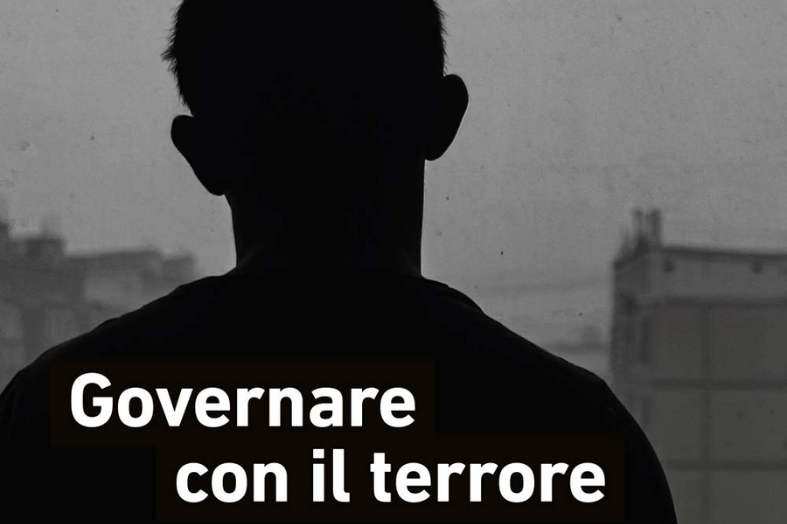
Giorgio Bianchi, “Governing with Terror: Propaganda and Power in the Age of Globalized Information.” Meltemi 2022

I am the Minister of Fear, and as you well know, without fear, there is no life! A society without fear is like a house without foundations: that’s why I will always be there in my white office, with my white desk in front of my white poster… Oh, how scary! I will always be there with my tools, my control panel: yellow button, orange button, red button, respectively, not very afraid, quite afraid, very afraid. And by correctly following this state of mind, I help the world maintain order.
Antonio Albanese
Each of us simultaneously inhabits two very different worlds: the real world and the narrative world. The real physical world of matter, of atoms and molecules, of stars and planets, and of animals that wander around trying to bite and mate with one another often has very little to do with the narrative world, made up of stories and mental chatter. Powerful people have long understood that if you control the stories people tell about themselves, you can control their resources and their reality. From priests to politicians, from CEOs to architects of war, everyone has deeply understood the importance of maintaining control of the narrative.
Caitlin Johnstone
Both Governing with Terror and my review begin with these two incipits.
As in a Gestalt already complete in itself, the beginning already contains the plot and the end.
Antonio Albanese’s quote sketches, through satire, a masterful description of the experience of social control through fear, which we can all relate to. The second speaks of control through stories, often used as with children, but for purposes that can be contrary to our growth as aware adults.
Whoever controls fear, desires, or expectations directs people’s thoughts and actions.
Fear and desire, a pain/pleasure lever that motivates and animates actions, consciously or unconsciously, towards any personal or marketing goal.
This is one of the threads woven into the text, which appears as a tapestry-labyrinth of information. The initial part describes the types of government that have manifested themselves in the recent past, starting from the analyses made by Hobbes, in particular in his work The Leviathan, and arriving at the present day, passing through the studies on the psychology of persuasion carried out by Freud’s nephew, Edward Barnays (1).
The author of this text is Giorgio Bianchi, a photojournalist and independent journalist who has often covered war zones. Since 2014, he has witnessed the events of Maidan Square in Odessa and has visited the Dombass several times. His perspective has brought different and critical insights to the narratives reported by Italian television and newspapers, as well as in Western media outlets following Russia’s intervention in Ukraine. He has documented his experience in those (and other) conflict zones, producing important interviews, documentaries (including one filmed simultaneously with the Ukrainian army, the Dombass popular militias, and the regular Russian army), and a photo essay entitled “Dombass Storie’s.”
This impressive 832-page book, which I chose to review in relation to the theme of fear and social contexts for this issue of the magazine, does something different. It’s not a field reportage, but rather a preservation of memory. The book is, in fact, a collection of ten years’ worth of articles, research, essays, news, and investigations, all hosted on the author’s Facebook page. The mastery I recognize in Bianchi lies in his ability to organize so much documentation, following a thread through the materials, punctuated by his brief reflections and analyses, but primarily serving as a link between all the different contributions. This function supports the book’s very mission, which I quote from the text:
Through messaging platforms or in the comments areas under posts, I receive a large number of links and information every day. In most cases, it’s inaccurate news, sometimes completely unfounded. (…) When I read that I’ve received a notification from certain contacts, I already know that the content will be absolutely worthy of attention and relevant to the reasoning being pursued at that moment. Thanks to this process of selecting and sharing material, my Facebook account has over time become a sort of repository containing the information, reflections, and analyses produced by what we might now define as a true “Intelligence,” a “Natural Intelligence.” A priceless heritage that could be erased at any moment with a click. Hence the need to put everything on paper, to prevent Facebook, or whoever, from one day sweeping away this wonderful mandala of information and reflections and thus nullifying all the work done to create it. If used intelligently and collaboratively, with no other purpose than to spread knowledge and broaden perspectives on reality, social media could be an extraordinary tool for connecting complementary skills. I understand that after reading pages and pages condemning them, these words may sound contradictory, to say the least.
As we have seen, social networks were created for military purposes. (…) But ultimately, no tool is intrinsically negative; everything depends on how it is used. Therefore, while we wait to reach a level of awareness that can once and for all neutralize the threat lurking behind social platforms and, more generally, behind the digitalization process, we must exploit their positive aspects to spread awareness (…). (Chapter Ten)
In support of the need identified by Bianchi, I realized he’s not the only one undertaking such an operation. Travaglio’s book, Scemi di guerra (War Scemi), was just released. It collects articles and documents published before February 24, 2022, with the aim of preserving as much as possible the sources and documents on which to base the memory of the facts, as well as investigating their veracity. This prerogative and function, among the most important of journalism, is evidently no longer a given; it almost seems like something to be affirmed and defended. At the recent presentation of his book on Visione TV, Travaglio, while maintaining that articles cannot be deleted from newspaper archives, noted that he had discovered one of them missing from online archives. I find this vision interesting, because if we want to consciously express choices that aren’t based solely on the pleasure/pain lever and are difficult to grasp consciously, we need to examine multiple sources, multiple pieces of information, so we can break them down through dialogue with diverse and opposing views, and then assimilate the concepts and translate them into critical and independent thinking.
And dialogue itself, especially critical dialogue, seems to be the great absentee of our time.
The mass of material collected by Bianchi describes a climate of constant emergency, based on fear. This scenario creates the conditions that justify hasty transitions, a lack of discussion regarding choices and positions to be taken. Everything seems to have to fall into line, as if there were a sort of protection from evil at stake, from which someone more adult, more responsible, experienced, and competent can deliver us, while we can watch Netflix or distract ourselves with any natural or artificial muscle relaxant, drug, psychotropic medication, or any other short-term pleasure that can be repeated ad infinitum, as we did as children, while adults already took care of everything for us.
According to this vision, we are witnessing and are all subjected to a potential social infantilization, from which not even a higher level of education, in itself no longer a sufficient antidote, can a priori save us. The text reports analyses and studies on the persuasions used in cases of high and low levels of education. This narrative now also leverages aspects and themes that distinguish informed people, such as science, the environment, and civil rights, creating an illusory sense of being right, when in reality everything is much more complex. Bianchi says:
For years, a process of constant and continuous weakening of the role of nation states has been underway in favor of transnational political entities, paralleling the progressive dismantling of social rights, replaced by the progressive expansion of civil rights to minorities. The press, or more generally the information world, which should have had a supervisory role over these processes, has also undergone a process of globalization, becoming increasingly concentrated in the hands of a few players, often linked to the world of big business or finance. This phenomenon has led to the range of primary news sources increasingly narrowing over time, leading to the current situation, where news items are constantly being released, driven by the need to be first, without giving those at the base of the information pyramid time to adequately verify or comment on them, or to correlate them with other news items on the same topics. At this point, information is most often simply forwarded to its readers through a process of copying and pasting primary sources. The result of this process is a constant flow of information circulating around the world at the speed of the internet, most of the time without journalists able to verify it on the spot, or even analyze it and correlate it with previously reported information. (…) We looked to the future with hope when the promoters of globalization envisioned, after the fall of the Berlin Wall, a future of progress and prosperity. As soon as the side effects of this process began to manifest themselves in our societies, we began to look to the future with growing fear. Today, when this promise of perpetual well-being seems to have definitively faded, our society has unknowingly produced a kind of crisis ideology, an ideology of emergency, which has imperceptibly yet inexorably insinuated itself at every level, from public spaces to the most intimate and private spheres, to the point of constituting in each of us a new way of thinking about ourselves as people. Our societies appear increasingly governed by governance based on prevention and the neutralization of risk (not to be confused with danger) as a fundamental requirement at every level and in every national and international, public and private context. In modern times, risk—of terrorist attacks, pandemics, environmental catastrophes due to climate change, financial market crises—is no longer a hypothetical event with a certain probability of occurring under certain conditions; risk now takes place in the present, becoming almost real and contributing to the growth of a condition of perpetual uncertainty, precariousness, and insecurity. Risk, in fact, depends on factors that, while belonging to the future and merely probabilistic, are nevertheless felt and addressed in the present. In this sense, the fear that prefigures a potential catastrophe is no less real than the catastrophe itself. Zygmunt Bauman believes that the main characteristic of fear today is that it is a “second-degree fear.” “A fear that, regardless of the immediate presence or absence of a threat, guides human behavior after modifying their perception of the world and the expectations that guide their choices.” Second-degree fear is a state of mind that can be summarized as a kind of fluctuating anxiety combined with a hypersensitivity to danger. From this perspective, fear detaches itself from its potential origins and transforms into a constantly perceived paranoid sense of threat. This process has so multiplied the possible causes of fear that it has ultimately become detached from its sources and transformed into a generalized sensation. Given its nonspecific nature, it can easily be traced back to origins other than those that actually generated it. The tendency to cultivate and knowingly divert the feeling of generalized fear is widely used to address the seemingly irreversible credibility crisis in politics and the media. Indeed, among the products most sold through the exploitation of feelings of anxiety and fear are undoubtedly “political products” and “journalistic products.” In practice, these very specific “consumer goods” fuel what we can easily define as a true “economy of fear.” Giovanni Arrighi often used the term “great deception” to describe the strategy employed by US government and intelligence agencies to spread fear among civilians, aiming to gain support by fostering hostility toward perceived adversaries or geopolitical enemies they intend to target: Al-Qaeda, Russia, Syria, Iran, China… The post-twentieth-century disillusionment regarding the possibility of politics as an effective tool for achieving real change in a world dominated by globalization is, on the one hand, leading to a total alienation of the ruling classes from their own electorate, while on the other, it is causing growing distrust of politics, which is consequently increasingly forced to invoke constant emergency situations to legitimize its power. For the same reason, the media also seek to maintain high public attention through constant appeals to the emotional sphere and a constant stimulation of the alarm threshold. The result is a vague sense of fear that can, in many cases, lead to the perception of the enemy’s presence everywhere: from the person with Middle Eastern features boarding a train or plane (who might be a terrorist), to the passerby we pass on the sidewalk without a mask. The point isn’t how much these individuals actually pose a threat to our safety; the question is through what cognitive lenses we are viewing the world. The risk, in fact, is that fear ceases to be a subjective feeling and increasingly becomes a genuine instrument of governance capable of regulating social relationships and divisions. Beyond a sentiment cultivated and scientifically disseminated through the mass media, which politicians draw upon to legitimize themselves and gain consensus, today we can envision fear as a genuine instrument of governance. Security needs currently dictate the organizational criteria of society’s most important institutions. In such a climate, the political leader has an easy time selling the image of a responsible and protective family man, aware of the dangers and the need to prevent them before they even arise, yet simultaneously uncompromising and tough against anyone who might endanger public health and safety. From this perspective, terrorists and dissidents, compared to security-based forms of government, end up constituting the third vertex of the power triangle: despite being considered a threat to public health and safety, they nevertheless serve perfectly well within the narrative that legitimizes the victims’ fear and the resulting authoritarian response from those in power, who then feel entitled to assume the role of protector. (chapter two)
This perspective seems to describe a world where progressive and liberal identities are supported in words, but in reality fences and isolated boxes are built, in which opinions and debates are segregated, increasingly sterile, because everything takes place within the same group of thought.
In this logic, through fear, dangerous, subterranean and cloaked in modernity, paternalistic and patriarchal relational processes gain strength. From this perspective, technological advances make us dream of previously unthinkable frontiers, such as the idea of immortality promised by the fusion of man and machine, thanks to artificial intelligence. At the same time, these achievements, if not supported by awareness, deprive us of the ability to confront difficulties, to confront the fear of death by making intentional choices that are contained in our experience, and therefore assimilable, implemented one step at a time. In this same direction, we would be deprived of the fundamental ability to choose our own destiny, to decide how much of the possible changes achievable thanks to technological progress we truly want to introduce as an alteration to our current human condition. Other perspectives start from the assumption that this choice has never been in the hands of human beings and never will be, as historian Yuval Noah Harari, also cited in the text, states. But here we would open a chapter that goes beyond a simple review and could provide an example of the dialogue I hope can be fostered in many places, thanks also to the work and book of Giorgio Bianchi and those like him who fight for a phenomenological perspective. A connection that arose within me from this reading is precisely how closely phenomenology relates to the profession of photojournalist. Of course, this isn’t a given; in fact, the risk of ideological drifts from all the opposing camps that have emerged is ever greater, and this too is extensively debated and addressed in the text. While reading, I found it very enjoyable to rediscover little gems of writing, or stories, or significant episodes that I had missed over time. I’ll mention one, transcribed from Baricco’s lecture on Alexander the Great’s dream, available on YouTube. The piece cited recounts his experience, which he personally experienced and which has become for him an emblem of the changing register underway in scoop journalism. The event was an invitation from the then editor of Repubblica to go and watch the passage of the Hale-Bopp comet four days before the actual passage, to score a narrative scoop and beat the competition. He did so. Thus, all journalists in the days that followed had to adapt to his piece, and the novelty of the actual passage, here and now, was squandered in favor of another storytelling. Thus, in that case, the narrative became the architect of the creation of a new reality. As the editor cited above said, “the comet passes when we decide.”
All of Bianchi’s theses are supported by the references he gathers and draws inspiration from, the insights and arguments of scholars and intellectuals from a wide range of disciplines, such as the aforementioned Hobbes, but also Pasolini, whose farsighted vision anticipated many of today’s situations. Surveillance Capitalism, by Shoshana Zuboff, published by Luiss University, is another important text for Bianchi. In relation to the logic it follows, he dissects it and explores it in conjunction with other texts and authors and as a backdrop to his reflections.
In short, a highly valuable read, with a clear thought, both appreciable and open to criticism, a rich collection of insights to explore, to engage in dialogue and explore the many facets of today’s complex, often unfamiliar world. Enriching exchange and discussion helps us develop new insights, to choose with greater clarity and autonomy how we want to address insecurities, fears, and disorientation, as we move toward something truly new for everyone.
(1) Bernays, L. E., (1923) 2011, Crystallizing Public Opinion, Ig Pub, New York, USA.
Bernays, L. E., 1928, Propaganda; Italian translation, 2008, Propaganda: On the Manipulation of Public Opinion in Democracy, Fausto Lupetti Editore, Bologna