
My experience with learning disabilities in childhood, and particularly with regard to the physiology of attention processes, the support of homeostasis, and spontaneous self-regulation, were the trigger for the proposed experiment, called LimEs, developed on the first day of the SGT 2024 conference, Margins at the Center, When the Background Becomes Figure.
I refer to an attachment at the bottom for a more detailed presentation of the program. In this article, I want to bring some considerations and what have been my backgrounds in the figure, which are: Gestalt, the work of Violet Oaklander, with Gestalt Play Therapy for children, MusicArTherapy in the Globality of Languages by Stefania Guerra Lisi and the experience of thirty years of work in the field, which has flowed into the method that I have called Dynamic Relational Art (AR.DI.RE.).
The connection that gave rise to this idea was the parallel between the frontal nature of theoretical presentations at conferences and school teaching, where the body is often no longer represented with its sensoriality and physicality, elements considered inappropriate. The personal individualities that pertain to them are absorbed into the black hole of chairs and frontal dynamics, both as a position of standing in front of and on the front of an asymmetrical and hierarchical boundary, and as parts of the body—the forehead, ears, and eyes—emissaries of a hidden and invisible frontal cortex, which would seem to be the only one authorized to express itself, according to the “liturgy” of the current school ritual. But how does the neocortex express itself to compensate for the body’s stasis, the need to release the tension caused by concentration and the forced insertion into a non-physiological posture, dictated by an external norm? Creative adaptation comes into play and protects, creating fluctuations in attention, escapes, discomfort, mind/body conflicts, dyspraxia, bad habits, physical or mental hyperactivity, etc., events which in turn are interpreted as “out of the norm” compared to a behavior or functioning considered adequate.
In writing this article, I reread some of Maria Montessori’s writings, an illustrious forerunner in this field and another interesting background to bring into the picture, in particular her concept of the child’s normalization phase.
Paradoxically, according to Maria Montessori, what was described above in terms of difficulty in staying within the learning process can be normalized. However, this term is interpreted in a way that contradicts common sense. The normalization she refers to is what she observed when the child rediscovers, to use Gestalt terms, his or her homeostasis and spontaneous self-regulation within different learning systems. She observed, in a period of approximately three months, that if the child is left free to move back and forth in his or her apparently deviant behaviors, he or she normalizes, that is, discovers the pleasure of learning, and, as a secondary effect, the symptoms of the previous phase also subside (La normalizzazione secondo Maria Montessori – Normalization According to Maria Montessori, Dr. Donatella Pecori).
If in schools and in many institutional and healthcare settings, we find ourselves faced with a divorce between individual specificities and the norm, and this unfortunately generates many symptoms and discomforts, Maria Montessori seems to tell us that the norm should be the non-norm, that is, the specificity of each individual, the care and maintenance of authenticity and discovery, the “help me do it myself” of the child who explores, understands, and learns the world from the world, experiencing the self in action, in the boundary contact between the organism and the environment.
Instead, in the common meaning, the norm coincides with the etymological meaning of the word, in its meaning of a set square that measures right angles and everything outside it, it is a deviation, an exit from the rule, from the ideal measure that is the same for everyone, as well expressed in the myth of the Procrustean bed. http://www.fondazionepsicologi.it/wp-content/uploads/2018/10/Il-letto-di-Procuste.pdf
This is not an acceptable background for us, as we are not interested in “normalizing” (..) https://figuremergenti.it/tag/numero-3-far-finta-di-essere-sani/
But another possible meaning lies hidden within the etymology of the word. According to another author (http://www.etimo.it/?term=norma), the word norma is a contraction of gnòr’ma, meaning “to make known,” which derives from the same Latin root as noscere, meaning “to know,” meaning “to make known.” Hence gnòma, a tool used by surveyors, the land surveyors who discovered new lands and marked their boundaries. When they were unexplored, they warned travelers by writing, “here are dragons,” or “here are lions.” Exploration, knowing, and knowing are about facing dragons and lions, the fear of emptiness and the unknown; they are about experiencing the ability to go beyond boundaries to discover new possibilities and use limitations as tools of knowledge.
In this sense, the LimEs experience proposal meant exploring new lands, seeing which dragons or lions could emerge on the horizon, implementing it for the first time at one of our conferences.
In the 1995 edition of the PHG, discussing Goodman’s thought, Michael Vincent Millerne, in his preface with Isadore Fromm, states: Growth comes from metabolizing the unknown, which is absorbed from the environment, and making it known, so as to transform it into an aspect of the self. And then further on, he comments on the poet Wallace Stevens’s phrase, “All things come to him/From the center of his farm,” saying: But, on the whole, one grows when one goes beyond the fence and the perimeter, where possessions lose importance and the wilderness of human contact approaches.
The structure of the experience was based on breaking free from the confines of the usual and the familiar, allowing this contact to be experienced through simultaneous and self-regulated sensory exploration, in small groups, with the ability to choose whether or not to move toward the stimuli, through physical movement in space and the activation of the senses and the pleasure of exploring combinations of shapes, materials, colors, body, and attention.
The realization of the idea was possible thanks to the conference organizing group and all the staff who welcomed and supported the experiment, as an emerging figure clearly belonging to and expressing the field of our school, of this moment.
I would like to extend a special thanks to Giulia Iseppi for her generosity in supporting me, despite my last-minute, blind request. We happily combined two reckless pursuits, as she, in turn, added her own poetic, narrative, and theatrical specificity to the complexity of the visual and plastic art I had developed. But we were there for each other, expressing our doubts and feelings, giving our redundancy a fertile, mutually enriching direction. We therefore modified the original structure along the way, integrating the idea of each participant fishing for a synchronic word, words to then be stitched together and used in the grand finale, as a collective poetic work, read by her in a profound and moving way (link to text).
The boundary between us has been fluid and shifting, always explored to avoid any “no man’s land,” potential for misunderstandings and misinterpretations. I found the support to be mutual. Beyond the practical help, I felt her energy, her pleasure in being there, and this strengthened my own pleasure. I believe Giulia’s willingness to support empowered her to be actively present, allowing her to take the space for personal experimentation that I appreciate, as it’s not always a given. She will be the one to say more or contradict, if necessary, speaking in person if she wishes. And in this, I want to reiterate Millerne’s words above: “Overall, we grow when we go beyond the fence and the perimeter, where what we possess loses importance and the wilderness of human contact becomes closer…” because I feel this is one of the strengths of our school model, which encourages us to get involved and take the space to grow, through co-construction, commitment, and belonging.
I’m grateful for the wonderful energy of the group of psychotherapy interns, and to Ermana, Alfredo, Rebecca, and Elisa who, despite everything and even getting involved at the last minute, wanted to be there, helped with the setup, and were available throughout the day.
Furthermore, getting to the point of presenting the experience, preparing it, and curating the background through staff discussions and the dissemination of a short presentation are all steps and initial results in themselves, as moving from wild ideas to implementation is not a given. As I wrote these notes, with the conference still open, none of us on the organizing committee knew how it would end, but we knew that in any case, the doing itself, the experiment, was a success, regardless of the outcome. What terrible thing could have happened? If no one had responded to our requests and suggestions, we would have welcomed the feedback, analyzed the data, and that would have moved us forward.
In short, we came up with something we valued together, working across our boundaries and boundaries, preparing the experience that then continued throughout the conference.
It was incredibly helpful for me to empty and reorganize my laboratory, which was almost entirely moved to the conference room, and it almost took a truckload. Aside from revealing my nature as a serial hoarder, masquerading as an art therapist, the abundance of materials, their unusual nature, were crucial in opening my perception to as many stimuli as possible. In addition to paints, I had sand, gravel, flour, Paesina cards, a deck of tarot cards, buttons, colored salts, dried flowers, eggshells, avocado shells, orange peels, various boxes, cardboard, hot glue guns and various glues, papers of all kinds, and much more. This was to encourage a material and sensorial approach, and to be in a constant shift between states of consciousness fueled by different sensory channels. As I touch the flour, parts of me are activated, memories, emotions, which are not the same as when I touch the sand. And while my sensory receptors process this, I move on to the experience of sensing what’s happening in the room, listening to the speakers, and, perhaps for a moment, simultaneously broadening my field of attention. I can have fun, in the sense of diverging, changing direction, branching off, alternating movements and patterns, thus freeing myself from the quagmire of stasis and habit…
In the post-conference period, there remains much to explore, much to discover or experience for the first time, many other aspects to describe, reflections to share, if interested, and windows of curiosity that can be opened. This writing could be expanded to include greater complexity, elements, and feedback from those who participated in the experience.
As previously announced, after the bibliography I attach the preliminary descriptive text, which serves as inspiration and background to the work.
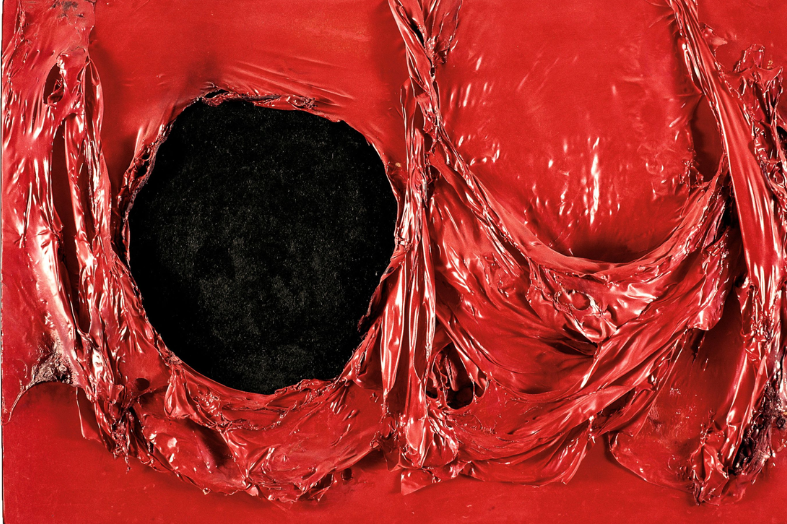
A special thanks to Fontana and Burri, whom I mention in the book, both of whom I touched by virtue of the courage they showed in breaking free from the confines and Procrustean beds of their time’s common sense. Some cut up canvases to see beyond, others used jute sacks to paint in the prison camp and escape through expression and the power of creation, despite everything.
BIBLIOGRAPHY
- Il gioco che guarisce. La psicoterapia della Gestalt con bambini e adolescenti,di Violet Oaklander, Edizioni Pina Catania 2009
- Il tesoro nascosto. Alla ricerca del sé del bambino. La psicoterapia della Gestalt per bambini e adolescenti, di Violet Oaklander, ed Homo Scrivens, 25 febbraio 2021
- Il metodo Oaklander. La psicoterapia della Gestalt attraverso il gioco, di Peter Mortola ed Franco Angeli 23 febbraio 2022
- Teoria e pratica della terapia della Gestalt, vitalità e crescita nella personalità umana, F. Perls,R.F. Hefferline, P. Goodman ed Astrolabio Ubaldini 1995
- Il metodo della Globalità dei linguaggi, Stefania Guerra Lisi, 1988 Borla
- Il metodo Montessori oggi. Riflessioni e percorsi per la didattica e l’educazione. Sonia Coluccelli e Silvia Pierantonio, Edizioni Erickson pag 89 (cap 5) La normalizzazione secondo Maria Montessori, dott.ssa Donatella Pecori.
WEBLIOGRAPHY
- Il letto di Procuste, Il rifiuto delle diversità di Fiorella Chiappi, 22 Ottobre 2018, Fondazione Ordine degli Psicologi della Toscana.
- Figure Emergenti n 3, editoriale Far finta di essere sani. Il difficile passaggio dall’essere normale all’essere sano, Mariano Pizzimenti.