

Il mondo contiene noi, che in parte lo conosciamo,
e il mondo di cui parliamo è ciò che ne conosciamo.
È il cerchio felice di cui siamo parte.
(“Sull’eguaglianza di tutte le cose”, Carlo Rovelli)
The era that “understood everything”
A welcoming room. Two armchairs, comfortable but not overly so, face each other near the window. The atmosphere is just right. The patient, Marta, sits composed, her hands clasped in her lap. She speaks with great clarity: she knows her own wounds, has read psychology books, and knows how to organize her story into an orderly narrative. She knows when her difficulty trusting began, recognizes recurring patterns in relationships, and self-deprecatingly refers to her “insecure attachment style.” She is, we might say, extremely self-aware.
A model patient.
Yet when he returns home, his choices are always the same. His body refuses to yield to explanations; life continues to flow along the same tracks.
This scene isn’t an anomaly. It’s a figure of the times.
We live in an era described as hyper-aware: mindfulness courses, self-help manuals, short psychology treatises flooding social media, a widespread familiarity with trauma, boundaries, and emotional dependencies. Yet the levels of suffering don’t seem to be decreasing. Rather, a subtle sense of stagnation seems to be increasing: “I know exactly how I function, but I can’t change anything. I feel better for a while, but in the end, nothing really changes…” It’s as if the mind has taken a step forward, leaving the body and spirit behind.
And it’s burnout right away… with the corollary of anxiety, stress, panic attacks, somatizations, depression.
What do we mean, then, when we talk about “awareness” in psychotherapy and healing practices? And above all: why does awareness, as we have learned to define it in the West, sometimes seem to skim the surface of life without transforming its fabric? To attempt to answer this question, we will bring together several trajectories of Western psychotherapy—psychoanalysis and its heirs, the thought of Daniel Stern and Ignacio Matte Blanco, Gestalt therapy and phenomenology, all the way to more behaviorally oriented therapies—with a constellation of figures from Taoist thought and Zen Buddhism, which for centuries have explored the connection between gaze, experience, and metamorphosis. The underlying hypothesis is that awareness alone is not enough when it is reduced to rational clarification; real change occurs in processes that are also emotional, symbolic, relational, and “poetic,” in which the logic is not that of the manual but that of the koan, the dream, the unsettling story.
In a world increasingly devoted to performance, measurability and “objective” evaluation, where the body/machine must be at the service of a specific production system, there are forces that go against the current, that seek “other” spaces in which to take care of the subject, not reduced to a simple cog but a “cell” of a larger social body, with which it resonates and coexists. These forces, which move transversally, connecting different fields such as philosophy, physics, science, art and psychotherapy, emerge from the need to counter the drift that seems to inevitably drag our society towards a destiny of alienation and eternal conflict with everything that is “other”, in a perspective of domination, conquest, exploitation. The risk is that we all transform ourselves into “little hands”[1], unaware agents of a social device that wants us to be sufficiently aware to be sufficiently healthy to be more than sufficiently “efficient”. Awareness must therefore be “sustaining”, certainly not “transformative”.
These forces, like small TAZs[2], are tolerated by the system that considers them a minority and sufficiently harmless. Where they manage to gain space and increase their impact, processes of “normalization” and deactivation promptly intervene. It happened with meditative practices, it is happening with the new psychedelic therapies.
Deforestation practices are followed by controlled reforestation initiatives.
The “wild” and natural dimension is replaced by a planned, ordered. Controlled. At the service of our needs[3]. They say…
We are the trees.
And yet… other wor(l)ds are possible. They have been in the past and still are today. There are lands where the seed of awareness gives life to thriving plants. There are lands where these plants are at home and are not uprooted under the accusation of being weeds.
To reach these lands, you need to look to the East.
The inflation of awareness
In recent decades, the term “mindfulness” has become fashionable. It’s the language of psychotherapy and corporate training, of secular spirituality and marketing, of stress reduction programs and “personal growth” plans. Brochures promise to “increase one’s emotional awareness,” companies promise to “develop self- and team-awareness,” and spiritual paths promise to “awaken to full awareness of the present.” The word functions like a totem: it is invoked, celebrated, and taken for granted.
It is rarely questioned in depth.
This widespread usage conceals several reductions. The most obvious is the cognitive reduction: awareness is easily equated with insight, with understanding one’s own mechanisms, with meta-reflection. I become aware when I “understand” why I do what I do, when I can name my emotion, when I recognize the origins of a relational pattern. This is intertwined with a moralistic reduction: awareness as absolute individual responsibility. If you suffer, if you get stuck, if you repeat the same mistakes, it’s because you’re not aware enough. A little more clarity and self-reflection would suffice, and things would fall into place. Finally, a technocratic reduction: awareness as a tool to optimize performance, to manage stress, to become more efficient, to better regulate one’s resources.
 In all these figures, something essential is lost. Awareness is thought of as a beam of light shining on the internal scene, possibly controlled by the ego, and change is considered a direct effect of this “illumination.” Simply by observing ourselves more closely, the shape of our lives changes. But clinical experience seems to disprove this illusion: how many people find themselves saying, “I understand everything, yet nothing changes”? How often does the work seem to stall precisely at the point where cognitive awareness is at its peak, as if a deeper part of us refuses to be converted by words?
It is in this fault line that space opens up for a different narrative: awareness is a (perhaps) necessary, but certainly not sufficient, condition for transformation. Or, more precisely, transformative awareness is more than mere rational clarity. It also involves the way the body feels, the way images are arranged, the way language bends into metaphor, the way relationships vibrate. It is an awareness that is poetic, veiled, rather than didactic; an awareness that knows more than the ego can say. To understand how it is constructed, we must return to the genealogies of awareness as they have been articulated in Western therapeutic practices, and then explore their declination in the Eastern world.
Psychoanalysis and its heirs: from the conquest of the unconscious to the field of awareness
If we retrace the history of psychotherapy, we observe that the word “awareness” has never been univocal. It developed within psychoanalysis as a promise of enlightenment, but was soon questioned, expanded, and turned against itself by its heirs. The Freudian formula – where the Id was, the Ego must take over – condenses the dream of an era[4]: to bring the night under the dominion of the day, to translate the dark into the clear, to transform the unconscious into the conscious. Analysis is conceived as an operation of conquest: what was repressed is interpreted, reconstructed, and brought to consciousness, in the trust that this will be enough to dissolve the symptom.
But a crack already appears in Freud: remembrance does not coincide with transformation; “awareness” can coexist with tenacious resistance. The founder himself, at a certain point, comes to grips with the fact that awareness, understood as mere rational clarity, fails to reach the heart of certain issues.
With Jung, this gap becomes a shift in perspective. If Freud envisions a predominantly repressed unconscious, tied to personal history, Jung opens up the collective: archetypes, primordial images, myth. Awareness is no longer simply shedding light on the past, but the encounter with an internal otherness that comes from deeper than the mere biographical dimension. Dreams, symbols, and fantasies are not simply disguises of sexual or aggressive content; they are messengers of a process of individuation that transcends the ego. Being aware, here, means learning to read the language of images, deliberately frequenting the spaces in which they manifest—active imagination, dialogue with internal figures—allowing oneself to be transformed by their logic. It is an awareness that is built more through immersion in a symbolic universe than through analytical deconstruction.
Lacan delivers another blow to the myth of the transparent self. If the unconscious is “structured like a language,” then the self-awareness of the self is always, to some extent, a misunderstanding. The subject does not coincide with the self that says “I”: it is an effect of the signifier, a lack inscribed in the symbolic chain. The analytic experience, from this perspective, does not aim to produce a subject master of his own meanings, but to make him pass through the “crossing of the fantasy,” to shift his relationship with his own desire. Lacanian interpretation is not clarification but rather a cut, an equivocation, a play on the signifier that fractures the network of imaginary identifications. Awareness, if one can call it that, is not stable knowledge about oneself but an encounter with the point at which knowledge falters, at which the Real that escapes representation emerges. In this tradition, the dream of an all-encompassing awareness is reversed: the subject constitutes itself precisely where it does not know.
Donald Winnicott, on another level, shifts the emphasis from knowing to being. He reminds us that before “knowing who I am”, I must be able to “feel that I exist”. Self-awareness, in its genealogy, does not arise from a solitary act of introspection, but from the fact of having been held and mirrored by a “good enough” environment. It is in the mother’s gaze that returns the child’s gesture, in the continuity of holding[5], in the potential space of play that the child begins to experience a non-fictitious “I am”. If this process fails, the subject constructs an adapted false Self that may also be extremely “aware” in an intellectual sense, but does not feel the fullness of its own existence. For Winnicott, the clinical space is first and foremost a space of play: there, awareness manifests itself as the possibility of experiencing one’s true Self in the presence of another who neither intrudes nor abandons. More than realizing, the patient must be able to surprise himself by existing – and by being seen while existing.
Subsequent developments are grafted onto this scenario which radicalise the idea that awareness is not a beacon of the ego, but a field process. Wilfred R. Bion transforms interpretation into rêverie[6]: what heals is not so much the content of the explanation, but rather the analyst’s ability to host within himself, in a state of “without memory and without desire”, formless beta[7] elements and to return them to the patient as possible thoughts. Awareness becomes the ability to dream the patient’s undreamed experience. In Bion’s terms, it becomes the ability to approach O[8], that “ultimate unknown” which cannot be possessed as knowledge but only frequented as experience.
Cristopher Bollas adds a precious piece with the notion of the unthought known[9]: something that the subject “knows” without ever having thought it, a knowledge deposited in forms of life, in tastes, in style, in gestures, in choices. It is an embodied, pre-reflective awareness that inhabits the person before he or she can narrate it. Analysis, from this perspective, is a place where the unthought known can slowly take on words, images, metaphors, without ever exhausting itself in them. Once again, understanding does not coincide with possessing; awareness is a process that only partially translates a broader knowledge.
Thomas H. Ogden emphasizes the shared nature of this process. He introduces the idea of the “analytic third,” a field co-constructed by patient and analyst that belongs to neither, but includes both. Awareness, here, is not the act of an isolated subject, but something that happens between, in the way the two participants dream together, speaking “as if they were dreaming” and experiencing shared affective states. Ogden describes sessions in which the dialogue itself dreams, producing images and thoughts that neither could have elaborated alone. The “knowledge” that emerges is therefore more akin to a poetic text composed by several hands than to a diagnosis.
 Starting from Bion, Antonino Ferro and Giuseppe Civitarese further develop the notion of the analytic field. The room becomes a shared dream device, where what happens—dreams, slips of the tongue, images, even banal incidents—is read as material from the field. Awareness, in this context, coincides with the ability to “dream the session,” to transform raw events into narrative fragments, characters, and microstories. Ferro, speaking of “psyche as cinema,” suggests that therapeutic work is not about extracting pre-existing truths but about generating narratives that allow affects to circulate, raw states to find form. Civitarese emphasizes the aesthetic aspect of this experience: awareness is contact with a form of beauty, even when it concerns pain, because it brings order to chaos, creating a figure where previously there was only formless saturation.
Another author who pushes awareness out of its comfort zone is George Devereux, a bridge between psychoanalysis and anthropology and the father of modern ethnopsychiatry. With his complementarism he shows that there is no such thing as “pure” observation: the analyst is always implicated, with his own culture, his own categories, his own history. Awareness, then, does not only concern the patient’s contents, but also and above all the observer’s reactions, his countertransference, not only individual but cultural[10]. To take care of another – whether the “internal other” or the other belonging to a different culture – one must recognize that one’s own reason is situated, partial, crossed by collective ghosts. Devereux thus broadens the field of awareness: from intrapsychic to interpsychic, from individual to historical-cultural.
Along this psychoanalytic axis, other psychotherapeutic traditions have explored ways of being aware. Phenomenological psychotherapy, with figures like Jaspers and Binswanger, shifts focus from causes to the world’s ways of appearing. Karl Jaspers distinguishes between explaining and understanding: it’s not just a matter of identifying mechanisms, but of empathetically entering into the structures of another’s experience, of carefully describing the forms of delirium, anguish, and melancholy as they are experienced. Awareness, here, is an operation of phenomenological clarification: making visible, without reducing, the other’s own world.
Ludwig Binswanger, with Daseinsanalyse, brings this movement even closer to Martin Heidegger: mental disorder is not merely an internal dysfunction, it is a transformation of the way of “inhabiting the world.” Being aware, in this perspective, means grasping the structures of being-in-the-world: private worlds, interrupted projects, horizons of meaning. The therapist not only helps the patient understand “where” a symptom comes from, but also to realize “what world” he inhabits and what possibilities are still conceivable.
Umberto Galimberti, drawing together many of these threads, insists that the psyche is not an internal object, but the name we give to how we inhabit a world of meanings, symbols, and techniques. Awareness, then, is not merely introspection, but the ability to see the cultural forms that think about us, the language that inhabits us, the technique that structures our daily gestures. In “Psyche and Techne,” Galimberti shows how the West has exacerbated the register of instrumental reason and how contemporary suffering is linked to an impoverishment of the symbolic: healing awareness must rediscover myth, ritual, and images, not simply explain the mechanisms of reality.
Against this complex backdrop, Gestalt therapy and Stern’s work emerge less as alternatives and more as convergent heirs. Gestalt therapy shifts awareness to the organism/environment boundary: it’s not so much “knowing oneself” as sensing what, in the here and now, stands out like a figure against a background. The cycle of contact—sensation, awareness, action, withdrawal—describes awareness as a transition, as a change in the state of the field. Experiments aren’t meant to “apply techniques,” but to create situations in which the body can know firsthand what reason has long known, and vice versa. In this sense, Gestalt therapy draws closer to Winnicott in his insight that only by playing, only by acting, only by risking a full gesture can one become aware in a strong sense.
Danile M. Stern, for his part, draws attention to the implicit level of relationships. He reminds us that much of what we “know” about ourselves and others does not pass through reflective awareness: it is procedural memory, relational style, rhythm. Implicit relational knowing[11] is a form of embodied awareness that manifests itself in the micro-choreographies of contact. The moments of meeting[12], those brief instants in which analyst and patient meet in a shared affective truth, are moments of awareness in the fullest sense: something that had always been experienced but never recognized becomes, for an instant, a word, a look, a gesture, and from then on it can no longer be ignored.
If we observe this constellation of authors and schools of thought—ranging from Freud and Jung, through their psychoanalytic heirs, to phenomenology, Gestalt, and ethnopsychiatry—the figure that emerges is clear. Over time, psychoanalysis and its heirs (or traveling companions) have progressively dismantled the naive idea of awareness as a simple rational transparency of the self. They have shown that there are unthought knowledges that orient us, symmetrical logics that exceed clarity, shared fields that think through us, potential spaces in which the very possibility of existence is played out, worlds of meaning that determine us from the outside. Effective awareness, the kind that heals, is never simply “understanding”: it is coming into contact with these different dimensions, allowing ourselves to be touched by their logic, allowing dreams, bodies, relationships, and cultures to reorganize, each in their own way, the way we exist in the world.
Two logics of change: linear and poetic-paradoxical
One could say, schematically, that Western therapeutic culture has oscillated between two logics of change. On the one hand, there is a linear-causal logic, according to which change occurs when the causes of a distress are identified, dysfunctional beliefs are corrected, and different decisions are made. In this model, awareness is primarily cognitive: recognizing the connection between event and reaction, between injury and symptom, between thought and emotion allows—at least in theory—one to choose another path. Therapy, within this framework, forms a more self-informed individual, more capable of controlling behaviors and regulating internal states.
In many cases, in this linear logic that traces a direct and exhaustive connection between cause and effect, between disease and symptom, awareness risks becoming the path that leads to the drug, to the biomedical solution that “fixes” a defective mechanical body.
This logic has its own power, especially when dealing with behavioral automatisms or rigid thought patterns. But it struggles to explain those transformations that occur “suddenly” and yet seem to have been prepared over a long period of time; those moments when a patient describes having had a dream that “changed everything,” or when a single encounter, a phrase, a metaphor act as a detonator. And it also struggles to explain why these transformations often fail to occur, despite having drawn a straight line between symptom and cause.
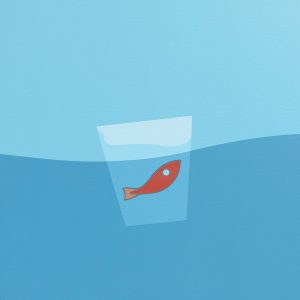 Where this straight line becomes dashed and at times karst, linear logic shows its limits.
Alongside it, we can recognize an alternative poetic-paradoxical logic. Here, change is not simply the effect of causal understanding, but of an encounter with a resonant form: a dream scene, an image, a tone of voice, a seemingly absurd phrase. Something is transformed not because it has been demonstrated, but because the subject finds himself involved, gripped, touched by a meaning that exceeds explanation. The psychoanalytic dream, the Gestalt experiment, Stern’s moment of meeting are figures of this logic: experience is suddenly reorganized, as if the pieces of perception and feeling find a new composition.
This second logic is closer to art than to technique, closer to the koan[13] than to a mathematical formula. It is the same logic that animates many Zen sayings that seem like nonsense until, in a certain context, for a certain practitioner, they suddenly become crystal clear. Or the Taoist tales of Zhuangzi, which do not explain the Tao but show it in oblique parables: a turtle that prefers to drag its tail in the mud rather than be venerated dead, a cook who carves an ox following the lines of the void between the joints. Here “understanding” is not a mental act, it is a mutation of the entire way of being in the world. It is metamorphosis[14].
Transformative awareness—the awareness that should be of interest to psychotherapy and healing practices—arises from the intertwining of these two approaches. Careful and patient work of clarification, deconstruction of stories, and cognitive processing is necessary. But this work remains fruitless if it doesn’t open itself to experiences in which meaning transcends the “already thought,” the known. Experiences in which meaning often manifests itself in poetic, paradoxical, and symbolic forms.
Matte Blanco: Bi-logic and the Limits of Rational Awareness
Ignacio Matte Blanco takes Freud’s idea of the unconscious seriously, but takes it to unusual terrain: that of logic and set theory. For him, there are not two separate worlds—a conscious realm of reason and an unconscious realm of chaos—but rather a single mind that functions according to two intertwined logical modes: an asymmetric logic, that of consciousness, argument, and time, and a symmetric logic, which largely characterizes the unconscious.
Symmetrical logic treats parts as if they were the whole, individuals as if they were equivalent, time as if it had no direction. In symmetry, the beloved is not just one person among others, but the totality of the possibilities of love; an offense suffered today can be worth as much as all the offenses of a lifetime; an “always” and a “never” can coexist with a “now.” The unconscious thinks in terms of infinite sets, in which each member represents the whole. In this regime, logical contradictions lose force, nuances flatten into equivalences, metaphors are not ornaments but structural modes of organization: saying “my mother is a tiger” is not a comparison, it is a symmetrical condensation of sets of experiences.
Asymmetric logic, the one we normally use to think and speak, does the opposite: it distinguishes, orders, situates in time, separates the particular from the general, recognizes that “today is not always” and that “this person is not all people” and, above all, is not a tiger! It is the logic that makes science, reasoned discourse, and reflective self-awareness possible. It is Aristotelian logic. Awareness, as it is often understood in psychotherapy, belongs above all to this register: bringing it to consciousness means translating symmetrical movements into asymmetrical forms, recognizing that that “absolute” anguish belongs to a certain situation, that that “nobody understands me” is not eternal evidence, but a tendency.
Matte Blanco’s bi-logical theory immediately illuminates a delicate point: if the unconscious operates largely with symmetrical logic, it can never be fully “made conscious” in the asymmetrical sense of the term. Every translation involves a loss, a cut, a reduction. When the patient says, “I realize that my anger toward her also includes my mother,” he is taking an important step, but this step does not exhaust the symmetrical density of that affect. There remain areas in which the experience continues to function as if the analyst were truly the totality of the story, as if that episode were the only one, as if time did not exist.
From this perspective, rational awareness appears both necessary and structurally limited. Necessary because it is the only way to articulate differences, to introduce margins of freedom from the indistinct. Limited because it can never fully capture the symmetrical logic that inhabits the subject. Here, the poetic dimension—dream, metaphor, image—is not a contour, but the place where symmetrical logic expresses itself in its own language. The dream that condenses different people into a single figure, the dream scene in which “everyone” is looking at me, the panic in which “there is no way out” are manifestations of this logic that exceeds asymmetrical awareness.
 Matte Blanco, without explicitly speaking of Zen or Taoism, nevertheless opens a space for dialogue with these worlds and confirms the idea that there exist modes of psychic functioning that, by their structure, elude the grasp of rational awareness, yet profoundly organize life. The transformation will not, then, consist in bringing everything to consciousness, as if one could completely convert the symmetrical into the asymmetrical, but in modifying the relationship between these two levels: allowing the ego to recognize the signals of symmetrical logic, to avoid being overwhelmed by it, to dialogue with it through its own symbolic channels.
In other words, Matte Blanco’s bi-logic further sharpens the distinction between the linear-causal logic of cognitive awareness and the poetic-paradoxical logic of profound processes: they are not simply two ways of describing the same thing, they are two different logical regimes that must learn to coexist. The therapist who limits himself to asymmetric clarity risks never truly encountering the patient’s symmetrical logic; the therapist who abandons himself to symmetry without any work of differentiation risks getting lost with him in the chaos. Clinical work, and with it transformative awareness, inhabits the border between these two worlds.
Christopher Bollas, in “The Eastern Mind”, seems to explain what Matte-Blanco intuited, tracing these two different logics back to the ways of thinking and being in the world that characterize Western and Eastern thought respectively:
“The Western and Eastern minds appear to represent opposing and incompatible traditions of thought. The Eastern mind is concerned with the liminal power of the single moment, with the temporality of the transitory. The Western mind is grounded in linear continuity; temporality is understood as the passage of time necessary to bring things to completion. Just as the spiritual potential of life’s moments seems lost to the Western mind, the Eastern mind would seem to have little interest in the sequential logic of Western discourse.” (p. 40)
Awareness and control: behavioral and cognitive-behavioral therapies
At this point, the Western panorama would not be complete without a look at more behavioral and cognitive-behavioral therapies, which have given a still different, and today increasingly influential, interpretation to the concept of awareness. Classical behaviorism, in its most radical forms, viewed everything unobservable with suspicion: what mattered were stimuli, responses, reinforcements, and behavioral chains. Data and measurements. Consciousness, in this framework, was either an epiphenomenon or a black box irrelevant to the prediction and control of behavior. Awareness was not a privileged tool for change; at best, it was seen as a byproduct of new habits acquired through schedules of reinforcement.
With the evolution toward cognitive-behavioral models, the internal scene comes back into play, but in a particular form. Attention shifts to automatic thoughts, core beliefs, and cognitive patterns: becoming aware means learning to recognize these thoughts, question them, and replace them with more realistic or functional formulations. Awareness, in this context, is closely linked to monitoring: monitoring situations, moods, and interpretations, identifying distortions, and applying restructuring techniques.
In the so-called “third waves” – such as ACT[15], DBT[16], mindfulness-based protocols[17] – awareness takes on a different face, closer, at least apparently, to contemplative traditions. We speak of mindfulness, acceptance, defusion of thoughts, non-judgmental observation. The patient learns to notice what happens in his own body and mind, to let the contents pass without identifying himself, to choose actions in line with his own values. We could say that here awareness splits: on the one hand it remains anchored to a task of control and self-regulation, on the other it opens up to a dimension of decentralized observation that seems to echo, at least in part, Eastern meditative practices.
This conceptual and technical heritage has offered powerful tools, especially for symptom reduction and intervention for specific disorders. But at the same time, it highlights significant limitations. Awareness, in many of these protocols, risks becoming a function of “management skills”: I become aware to better control my reactions, to avoid relapses, to choose more useful behaviors. The implicit horizon is often that of a subject who must increase their capacity for self-monitoring to be more effective, more stable, and more efficient. Linear-causal logic, here, dominates: I recognize a stimulus-thought-emotion-behavior chain and intervene on its links.
What often remains obscured in these types of devices is the symbolic and poetic dimension of experience. The dream is rarely central; imaginative material is sometimes considered merely as a carrier of beliefs. The unconscious as a symmetrical logic, in Matte Blanco’s perspective, lacks a true space for dialogue. Even when mindfulness is introduced, the risk is increasingly reduced to a stress-regulation technique, a mental hygiene tool, losing the radical nature of the practices from which it arises: the questioning of the ego, the perception of emptiness, the suspension of any plan for total control.
This does not mean opposing behavioral and cognitive-behavioral psychotherapy en masse to a vague ideal of symbolic depth. Rather, it means grasping their limitations and implicit implications: if awareness is defined primarily as the ability to monitor, correct, and manage, it remains embedded in linear-causal logic and the paradigm of the subject as self-manager. Where suffering arises from profound symbolic nodes, from implicit relational structures, from symmetrical dynamics that escape control, this model reveals all its limitations.
Matte Blanco’s thought reminds us that there are entire territories of experience that cannot be traversed by an awareness understood as rational self-monitoring.
The dialogue with Taoist thought and Zen philosophy opens a space for working in which to fundamentally question the very idea of a subject perfectly in control of his own awareness.
Taoism: Awareness as Alignment with the Tao
In Taoist thought, the word “awareness” could hardly be isolated, as it is in the West. The Tao is not an object to be observed, not a content to be conscious of, but a process, a path, a movement that permeates all things. The very idea that there is a subject who “is aware of the Tao” risks contradicting the heart of the teaching: the Tao cannot be grasped, and any attempt to possess it distances it.
There are numerous passages in Lao Tzu’s Tao Te Ching that illustrate these concepts. Obviously, in a subtle and symbolically dense manner. Here are a couple of them as examples:
“The Tao that can be called Tao
it is not the eternal tao
the name that can be named
it is not the eternal name
nameless is the beginning of heaven and eart
and with the name is the mother of all things
therefore he who is always without desires
he contemplates its perfections
but he who always has desires
for this reason it contemplates its boundaries
now these two things
they were born together and have different names
together they call themselves the mystery
mystery deeper than the mystery
and they are the door to every wonder”[18]
(Chapter 1, ed. LiberLiber)
“Inversion marks the motion of the Dao,
and weakness dictates its operation.
The Multitude of Beings, under Heaven, lives in the domain of manifest reality,
and that which is “manifest” draws life from that which is “not manifest.”[19]
(Chapter 40, Einaudi ed.)
When the Dao De Jing insists on non-action, on wu-wei, it does not propose passivity but a different form of awareness: a seeing-feeling that does not force, that does not manipulate, that does not place the ego at the center as a director. The Taoist sage is not the one who knows more quantitatively, but the one whose gesture is so closely aligned with the situation that it seems effortless. Awareness, here, is “alignment”: the body that senses the rhythm of things, the mind that does not incessantly question, the subject that lets itself be carried by the flow of events without dissolving.
 Zhuangzi, with his stories, makes this logic concrete. The dream of the butterfly—the man who dreams of being a butterfly, or the butterfly who dreams of being a man—is not an abstract metaphysical game: it challenges the subject who presumes to be the stable center of experience. The cook Ding, who carves the ox following the gaps, who tires not because he doesn’t force the blades against the bones, embodies a corporeal awareness of the Tao: it is the hand that “knows” before the head, an implicit knowledge that has formed over years of practice until it has become art. There is no ego that controls every movement: there is a field of attention that allows the appropriate gesture to emerge.
From this perspective, the equivalent of what we would call “awareness” is closer to what some texts describe as clear-mindedness, shenming: a light without an owner, a clarity that consists less in self-reflection than in no longer being blinded by rigid desires, fears, and all-encompassing identities. The subject does not possess this clarity; rather, he or she is a passageway to it, a place where something clarifies. It is no coincidence that Taoist texts are wary of words: naming too much, explaining too much, is already a way of stiffening the movement of the Tao.
If one attempts to look at psychotherapeutic awareness from this perspective, one senses a tension. Much Western treatment is structured around the ego observing, analyzing, reflecting on itself, monitoring its own states to regulate them. Taoism invites us to shift the emphasis: what matters is not so much who observes, but the quality of the field in which this observing occurs. It’s not about increasing the lights shining on our interior, but rather about softening the attachments that prevent the subject from flowing with life. Awareness thus approaches an art of subtraction: removing rigidity, removing effort, removing the pretense of control. This is a crucial lesson for those who, in therapy, risk turning awareness into a cage rather than an opening.
Zen Buddhism: Awareness that Breaks the Narrative
If Taoism suggests a movement of alignment, Zen[20] works even more directly on the breaking of habitual forms of consciousness. Traditional language speaks of satori, of awakening: an instant in which the ordinary way of perceiving oneself and the world cracks and what previously appeared compact is revealed to be a fabric of interdependencies, empty of its own essence. It is not a question of adding information: the practitioner does not “know more” after satori, in the sense in which a student possesses more knowledge after a course. Rather, it is a question of seeing differently, as if the focus were changed and with it the entire landscape.
This moment of awakening doesn’t appear suddenly. It is preceded by years of practice, discipline, and repetition. Seated meditation, zazen, offers an extreme form of objectless awareness: staying, breathing, letting thoughts come and go without grasping. In this seemingly empty repetition, something happens that words struggle to capture: the body learns another existential posture, a different relationship with the mental and emotional flow. Awareness, here, is less about “realizing what happens within oneself” and more about “being in what happens without completely identifying with it.”
The koan is perhaps the most disturbing figure in this pedagogy. Formally, it is a question, a brief dialogue, a paradoxical story: “What is the sound of a single hand?”, “Show me your original face before your father and mother were born.” The practitioner is invited to meditate on this enigma, to present an answer to the master, to let the question inhabit them. If the logic were that of the riddle, it would be enough to find the “right” solution. But Zen insists that there is no correct answer in a conceptual sense: there is a certain type of gesture, of presence, of quality of being that manifests itself or does not. The function of the koan is not to convey a content, but to short-circuit habitual thinking, to push the entire organism towards a leap. To create a space of disorientation.
In this situation, the quality of awareness is not measured by how well the practitioner can explain the koan, but by how they act, how they sit, how they breathe, how they look. It’s not an object the ego holds in its hand, it’s a way of being. If we think about psychotherapy, the most obvious parallel is with those moments when words are no longer enough and what matters is the quality of silence, the intensity of presence, the way the therapist conveys an image, the decision to take seriously even the patient’s minimal gesture. Here too, change occurs not because the formula has been found, but because the posture has changed.
Meeting points: insights, experiments, koans, stories
The moment in analysis when the patient suddenly connects a recurring dream to an ancient fear, and this connection is not just a thought but an emotional jolt, a shudder of the body.
The culmination of a Gestalt experiment in which a person, after addressing the “empty chair” with words never said to a parent, feels a tension he had been carrying around for years ease away.
The moment of meeting described by Stern, in which an exchange of glances or a phrase said at the right time resolves a relational impasse and inaugurates a different way of being together.
The flash of satori in a Zen monastery, after a long meditation.
The koan that suddenly seems obvious.
The Taoist tale which, reread for the umpteenth time, takes on a surprisingly different flavor.
In all these cases, we could speak of awareness, but it would be misleading to imagine it as a process that leads to additional information. It is rather a change in configuration. One form cracks, a new form emerges. What was previously background becomes figure, the field of experience reorganizes. The “I know” that the subject might utter after these events—”now I understand”—is almost a belated echo of a process that occurred earlier, elsewhere, with another language: that of the body, of the image, of relationship, of paradox.
The role of poetic forms is crucial. The analytic dream is not a simple story; it is a condensation of feelings and desires that the mind, unable to express directly, transforms into theater. The Gestalt experiment is a staging in which the patient can embody a role different from the usual one, and in this temporary theater something real happens. The koan, in its apparent senselessness, is a linguistic sculpture made to break: it shatters the linearity of thought, opening a gap through which another intelligence can emerge. Taoist tales are parables that do not close, but leave the reader suspended in a questioning smile.
All these experiences have a common thread: the transformation doesn’t happen through a linear explanation, but through a broader aesthetic experience. The subject is touched by a form, and this “touch” changes their way of perceiving.
And therefore to be.
In this sense, the Freudian unconscious and the Tao, the Gestalt field and the Zen void, implicit relational knowing and the clear mind, the symmetrical logic of Matte Blanco and the paradoxical logic of koans have something in common: they all refer to a dimension of meaning that cannot be exhausted by rational language and which nevertheless – or perhaps precisely because of this – guides life.
Towards a plural theory of transformative awareness
In light of this journey, awareness no longer appears as a single function of the ego, but as a web of dimensions. The cognitive component is undeniable: the ability to name what one experiences, to recognize a pattern, to connect events are all part of it. This dimension is precious because it allows us to break through the opacity of symmetrical thinking. But alongside, or perhaps beneath or above, it is accompanied by other fundamental components.
First of all, there is an affective-corporeal dimension: the possibility of feeling one’s emotions in the body, of holding their intensity, of discovering their nuances, of recognizing that certain muscular contractions, certain withdrawals of breathing are also forms of awareness..
 Then there is a symbolic-poetic dimension: dreams, fantasies, metaphors, images that surface in sessions, seemingly bizarre associations, phrases that “resonate.” This dimension is the one that best connects psychotherapy, Taoism, and Zen. On the one hand, the Freudian psyche speaks through images; on the other, Eastern traditions work through stories, paradoxes, koans. In both cases, awareness cannot be reduced to logical propositions; it is a work of meaning that unfolds in narrative, figurative, and analogical forms and is rooted, in Matte Blanco’s words, in symmetrical logics irreducible to asymmetric clarity.
Finally, there is a practical-relational dimension: awareness is also measured in what a person does, in the choices that suddenly become possible, in new ways of being with others. It is not just a matter of knowing that “I have the right to say no”, but of being able to truly say no to someone, with a voice that does not break. It is not just a matter of understanding that one is worthy of being loved, but of realizing that one is choosing a partner who does not repeat the previous script. In this sense, awareness is inseparable from action, just as Zen insists on the concrete gesture, on the posture, on the act[21].
More than a function, then, awareness appears as a configuration of the person-world field. It’s not simply something the subject possesses, to a greater or lesser extent. It’s the way in which the body, mind, relationships, language, and symmetrical and asymmetrical logics are arranged in a given moment. The dialogue with Taoism and Zen, with Matte Blanco and with therapies that emphasize the dimension of control, allows us to push this intuition beyond Western individualism: if the clear mind has no owner, if Zen awareness doesn’t coincide with an externally observing self, if symmetrical logic continues to operate beyond consciousness, then we can think of therapeutic awareness as a field event, something that happens between, and not just within.
From this perspective, another point also becomes clear: a part of experience must remain opaque for transformation to be possible. Not everything needs to be clarified, interpreted, named. There are silences that work more than many words, there are dreams that shouldn’t be immediately explained, there are gestures that are best left to resonate. The myth of total transparency—seeing everything, knowing everything, accounting for everything—risks being a sophisticated form of control, suffocating that dimension of mystery without which the transformative process fizzles out. The plural awareness we speak of includes the ability to inhabit the mystery, the unknown. To recognize our shadow and inhabit it without fear.
The “between”: awareness as an interstitial event
If awareness no longer appears as a torch in the hand of the ego but rather as a configuration of the field, then it becomes inevitable to name that which, in that field, belongs to no one and yet determines everything: the between. Not “I,” not “you,” not “inside,” not “outside,” but that subtle zone where forms approach without coinciding, where experience becomes figure precisely because it is not fully “illuminated.” We have glimpsed it in previous chapters: in Ogden’s analytic third, in Bionian reverie, in the contact boundary of Gestalt, in Stern’s moments of meeting, in the ownerless Taoist clear mind, in the Zen koan that breaks conceptual hold. But if that between has until now remained implicit, François Jullien and Ben Kimura offer words capable of making it thinkable without betraying it. It is interesting to note that this theme has been explored in depth by authors who in turn represent a “between,” who have built bridges between worlds to use tools and concepts from another culture to make their own more readable and “workable.”
Jullien doesn’t think of the entre (the between) as a simple passageway, a corridor between two rooms. He thinks of it as a generative condition: it is in the écart, in the gap, in the distance that doesn’t separate but differentiates, that something is set in motion. Transformation occurs not through the addition of contents, nor through the conquest of an object called “self,” but through dis-coincidence: ceasing to coincide with one’s habitual form, with one’s rigid identity, with the phrase we’ve used for years to tell ourselves stories. Awareness, in this register, isn’t “knowing more” but creating (or discovering) an internal gap, a crack in the compactness of what’s already known, a chance to breathe between words. It’s a clinically recognizable gesture: the moment in which a patient, who until then had been telling his life story like a pre-written novel, suddenly realizes that that story is only a possible narrative, not reality. And in that instant, an interstice opens up in which something else can happen. Nothing has changed yet, yet something becomes possible, unexplored spaces open up. Jullien helps us identify this event: the minimal act that produces a difference, a fertile tension between what I was and what I don’t yet know how to be.
Ben Kimura, a Japanese psychiatrist and phenomenologist, radicalizes this intuition on the clinical and intersubjective side. Aida[22], the between, is not a simple relationship between two already determined individuals; it is the place where individuals are constituted, fray, and recomposed.
In the most serious situations, it is not only the self that is wounded, but the very structure of the encounter: the Aida, the between that holds together self, other, and world. When that between stiffens or collapses, the tacit fabric of the common is lost. When we face a stiffening, the between loses plasticity and becomes a hard, defensive, protocol-like gap: distance is no longer a living distance that allows contact, but a wall, a geometry. The world remains “there,” but it no longer circulates: no resonance, no shared evidence. When we witness its collapse, the between dissolves because the distance no longer holds. The boundary between me and the other, between inside and outside, between thought and world, becomes too porous. Otherness is no longer what grounds me, but what invades or empties me.
In both cases, what we no longer notice in ordinary life because it constantly sustains us crumbles: the web of implicit, obvious, and prejudiced assumptions. The backdrop we now take for granted. It’s not just a problem of mental content: it’s a problem that affects the entire universe we inhabit. The water we swim in suddenly transforms into something else, an alien element that no longer guarantees our survival.
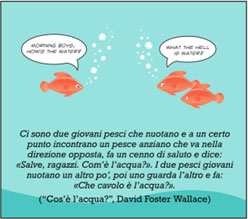 Even when Aida isn’t irremediably compromised, the cure can fail if it mistakes transformation for an increase in descriptive awareness. Because being more aware, in the sense of being better able to describe oneself, can remain a merely metalinguistic fact: I can better express what I feel, but that doesn’t change the way I connect, the way the world appears habitable to me, the way the other touches me without destroying me.
Suffering, therefore, is not so much within individual consciousness as within the structure of the encounter. Disturbances in the self’s identity are punctuated by disturbances in the encounter. From this perspective, if Aida is not “established,” a sufficiently consistent self is not established either: feelings of intrusion/usurpation, or, conversely, radical estrangement, appear, because the ipseity cannot sustain itself in the game of distance.
For the clinic, this should be a warning: a treatment that aims only to increase awareness as a self-description risks missing the point where life is formed: in the between, where contact, resonance, and a shared world occur.
Transformative awareness, however, often coincides with a reappearance of the between: the relationship ceases to be either fusion or absolute distance and returns to being a habitable space. It is there that the patient begins to experience his or her existence as “among others,” not as a monologue or siege.
This centrality of the between connects the work on awareness to the phenomenological threads previously explored. Jaspers, when he contrasts explaining and understanding, isn’t proposing an additional mental operation: he’s suggesting a shift in position in the encounter, a way of being before the other that creates a nonviolent between, capable of welcoming without reducing. Binswanger, in thinking of suffering as a modification of being-in-the-world, shifts the clinical focus from the “inside” to the “between”: the subject is such only in the fabric of his worlds, in his horizons, in the possibilities that come to him or close to him. And if Galimberti insists on technique and the symbolic as forces that pass through us, it’s because he sees that the between is not only interpersonal: it’s also historical, cultural, and linguistic. We are aware not only of what we feel, but of the world that senses us and shapes us.
Here, Nishida Kitarō’s thought can function as a conceptual hinge. Nishida speaks of basho[23], “place”, but not in the geographical sense: an ontological place, a field in which opposites imply each other. The subject is not a solid point that then enters into a relationship; it is an emergence within a place of relationships, and ultimately within a “place of nothingness” that is not a sterile void but an opening that makes every determination possible. If this language seems distant from psychotherapy, it is enough to remember what we have already seen: the analyst “without memory and without desire”, zazen as awareness without an object, the clear mind that does not belong. Nishida allows us to think about what, clinically, happens when the field empties enough to be able to generate: when we are not forced to coincide with our identity, with our symptom, with our already narrated story. The between, then, is not a simple “in between“: it is the basho in which the subject can stop being a prisoner of his own form and become a process.
This perspective also illuminates Matte Blanco in retrospect. If symmetrical logic exceeds the asymmetrical grasp of consciousness, then awareness can never be entirely “inside the head”: it will require a place where the symmetrical can be hosted without being immediately translated, reduced, or corrected. That place is often a “between”: the analytic field, the space of play, the frame of contact. And it also illuminates, by contrast, the limits of therapies that transform awareness into monitoring: when the subject begins to monitor himself incessantly, he closes the between, colonizes it, fills it with control. Paradoxically, he becomes too coincident with his own “conscious being” to be able to transform himself.
Transformative awareness is therefore not a property, but a gap. It’s what happens when between me and what I experience, between me and the other, between me and my words, a minimal gap is created that doesn’t separate but makes possible. It is in this gap that the symbolic breathes, that affect reorganizes, that insight ceases to be a statement and becomes an event. And perhaps it is precisely here that Taoism and Zen, with their strategies of subtraction, emptiness, and paradox, offer us an essential clinical lesson: it’s not about adding awareness, but about freeing the between in which life can once again flow and change.
Clinical implications: beyond psychoeducation, towards a poetic practice
If we take this plural and poetic conception of awareness seriously, therapeutic work takes on new nuances. First, we avoid the risk of slipping into a sort of psychoeducation aimed at conveying information about psychological functioning. Explaining what a panic attack is, what emotions are, and how an attachment is structured can be helpful, but that’s not where the heart of the treatment lies. When therapy is reduced to a didactic activity, it risks replicating the illusion that “knowing more” is synonymous with feeling better.
The consulting room, or whatever the treatment space, then becomes a laboratory of forms. The therapist pays attention to the patient’s dreams, not as material to be translated once and for all, but as narratives that accompany and guide the process. He or she is interested in the spontaneous metaphors the patient uses to describe their experiences; sometimes he or she returns them, expands them, plays with them. He or she works with the body, posture, and breathing. When appropriate, he or she suggests small experiments that allow the patient to enter the scene differently. The goal is not to accumulate insights, but to allow the field to find new configurations.
The therapist’s posture, from this perspective, resembles that of the craftsman of emptiness and paradox. On the one hand, he or she must be able to make space: not fill every pause with interpretations, not saturate the field with his or her own theoretical knowledge, not rush to reassure or normalize. On the other, he or she must be able to ask, when necessary, questions that function like little koans: not so much “Why are you doing this?” as “What happens if for a moment you don’t do this?” or “What shape does your fear take today, if you were to draw it?” These interventions don’t ask for explanations; they require experience. In this sense, therapy is closer to an art than a protocol: it requires sensitivity, intuition, and the ability to listen to the rhythm of the process.
Dialogue with Taoism and Zen can inspire, accompany, and strengthen this posture without succumbing to the temptation to superficially import techniques. It’s not about having patients meditate like in a monastery, nor about transforming the session into an explicit spiritual practice. Rather, it’s about allowing oneself to be imbued with other logics: the value of emptiness, the importance of inaction when action would merely be repetition, the unintentional attention that observes without immediately intervening. This can translate into very concrete choices: allowing oneself more time to allow an emotion to take shape, tolerating that a session ends with an open question, accepting that a significant transformation occurs in a dream between sessions.
Ultimately, the awareness that therapy cultivates is not that of a person who knows himself better and better, as if he could maintain a complete self-inventory. It is the awareness of a field in motion, learning to recognize its own knots without attempting to unravel them all at once, discovering that it can breathe even in the presence of conflict, and opening itself to the possibility that meaning may arrive through oblique channels.
Beyond the myth of the saving conscience
We began with a paradox: an era that seems to have “understood everything” about itself but struggles to change. We saw how psychotherapy, when it reduces awareness to rational comprehension or monitoring, risks feeding this same myth: all you need is clarity, all you need is the tools, all you need is knowing how it works. We listened, in contrast, to psychoanalysis, which pays more attention to dreams and reverie; Gestalt, which insists on the concept of the field and the process of contact; Stern, who demonstrates the power of implicit knowledge; Matte Blanco, who depicts the coexistence of different logics. We then juxtaposed these trajectories with the Taoist gesture that escapes the dominion of the ego; and the Zen narrative that breaks the narrative.
What emerges is a different kind of awareness. No longer a beacon that illuminates everything and claims to see everything, but a threshold: a porous edge where the cognitive, affective, symbolic, and corporeal intertwine, where symmetrical and asymmetrical logics touch, attract, and repel each other in a kind of dance, where the subject is not the master but rather a passage/landscape. A threshold that belongs not only to the individual but also to relationships, communities, and culture. A threshold that encompasses emptiness, ignorance, paradox, and image.
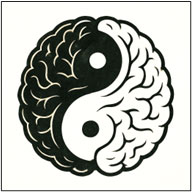 In this figure, awareness is no longer the promise that “consciousness will save you,” but the possibility of dwelling less uncertainly within complexity, of allowing oneself to be transformed by encounters, dreams, stories, and practices. A question remains that transcends the therapy room: what educational, training, and social tools would be needed to spread this kind of plural awareness? What would change in schools if, in addition to teaching skills, the ability to inhabit paradox, to listen to the body, to work with images were cultivated? What would change in healthcare institutions if “awareness” were not just an indicator to be measured with scales and questionnaires, but a collective process that also involves professionals, teams, and contexts?
Una consapevolezza che non pretende di chiudere le domande, che accetta di accompagnare e non di risolvere, che sa che una parte del lavoro avviene altrove – nei sogni della notte, nei gesti minuti della giornata, nei racconti che ci portiamo dietro, nei versi di una poesia, nel disegno di un bambino – è un primo passo oltre il mito della coscienza salvifica. È una consapevolezza più umile e più esigente, meno innamorata di sé e più interessata ai processi che, lentamente o all’improvviso, cambiano davvero il modo in cui stiamo al mondo.
_______________________________
[1] For Stengers and Pignarre, in “Capitalist Witchcraft”, the little hands (in the original petites mains, also translated as errand boys) are the daily operators who, without presenting themselves as “at the service of capitalism”, make the device work concretely: they implement, apply, put into action regulations, procedures, definitions, languages, criteria, “good practices”, etc., to the point of making them appear obvious and inevitable.
Their distinctive feature is a form of capture: they adhere to the “we must…” not as a simple observation, but as a legitimizing assent, and this adherence entails a sort of prohibition on thinking about what they are implementing (especially the consequences).
For this reason, even though they operate on a minute scale, they contribute to producing the overall effect of the “infernal alternatives” (those choices presented as “there is no alternative”), because they are the ones who make them operational, repeatable, “reasonable.” And the distinction is not a moral judgment: it is a pragmatic distinction, which is also recognized by the type of reaction (bewilderment, cynicism, aggression) when someone invites them to reflect on what they are doing.
[2] The TAZ (Temporary Autonomous Zone) is a concept developed by Hakim Bey, the pseudonym of Peter Lamborn Wilson (1945–2022), an American writer and essayist linked to the anarchist/post-anarchist area and to the counterculture. For Hakim Bey the TAZ is a tactic: creating spaces and times of real autonomy (social, political, imaginative) that temporarily escape formal structures of control, produce an intensity of life/action and then dissolve or move before being neutralized, without seeking a head-on clash or the permanent conquest of power.
[3] Our society is a device that induces needs, to feed the eternal and asymptotically growing cycle of production and consumption.
[4] Freudian psychoanalysis was born in Vienna in the late nineteenth and early twentieth centuries, a bourgeois and imperial capital where sexuality, desire, and conflict were strongly regulated by moral norms and a patriarchal family order. In that context, “hysterical” symptoms and neuroses also became a social language: indirect ways in which the body and mind expressed what could not be said openly. Freud therefore constructed a model of the psyche that responded to that cultural landscape: the centrality of sexuality, of the conflict between drive and repression, of guilt and authority, of the individual as an internal subject to be deciphered. For this reason, his theory is not a neutral universal system: it is a form of knowledge that bears the imprint of European modernity, of its devices of control, and of its specific ways of producing suffering and subjectivity.
[5] For Winnicott, holding is the set of care and conditions (physical and psychological) with which the mother (caregiver) “holds” the child: not only in her arms, but in the sense of containing, protecting, regulating, offering an environment stable enough to allow the newborn to feel continuous over time and “safe” as he grows.
[6] For Bion, rêverie is the mother’s (and, in analysis, the analyst’s) capacity to receive and “dream” within herself the raw emotional states of the child/patient: anxieties, sensory fragments, nameless tensions.
It is a receptive, involuntary psychic availability that functions like a mind digesting what the other cannot yet think. In therapy, reverie is therefore the analyst’s way of using his or her own internal experience (sensations, fantasies, micro-images, sudden emotions) as a tool for understanding and transformative containment: not to immediately “understand” rationally, but to allow the emotional experience to find mental form.
[7] In Bion, beta elements are the “raw materials” of experience: sensations, emotions and untransformed perceptual fragments, which cannot be thought, dreamed or remembered as mental contents. They are not yet symbols or representations: they are undigested psychic entities.
In the clinic, when beta elements prevail, the patient may bring to the session not so much “stories” or thoughts, but rather urges, somatic “knots,” nameless states of panic, impulses, and sensory fragments. In this situation, analytic work becomes, first and foremost, making thinkable what is currently only evacuable. These elements require a transformative process; only the alpha function (often supported by maternal/analytic reverie) converts them into alpha elements, that is, thinkable and dreamable contents.
[8] In Bionian theory O indicates the ultimate reality, the ultimate truth of experience. O is what is, before and beyond any description. It is not “knowledge” (K) and it is not a representable mental content. It is the unknown as such, the psychic “thing-in-itself”, the emotional event in its nakedness, what Bion also calls (depending on the context) Truth, Absolute, sometimes with almost “theological” resonances (without necessarily being religion).
O, therefore, is not known, it becomes. To “approach” O, it’s not enough to understand or interpret better: you need a mental disposition capable of tolerating the unknown (hence the analyst’s famous posture “without memory and without desire”), so that the emotional truth of the moment emerges.
In clinical practice, when Bion speaks of work “in O,” he is referring to work that aims to avoid immediately filling the void with explanations; to remain in touch with living experience (even when confused, even when raw); to foster a profound transformation (“transformations in O”), rather than a simple narrative or cognitive reorganization.
[9] For Christopher Bollas, the unthought known is a form of real but unrepresented psychic knowledge: something that the subject knows because he has experienced and incorporated it (especially in the very first relationships and in affective-sensorial micro-experiences), but which has never been thought of, symbolized or put into words. In the session, the work is not to immediately “explain” the unthought known, but to create the conditions so that that implicit knowledge can become thinkable (and therefore transformable), often through moments of strong emotional resonance and recognition in the here-and-now of the therapeutic relationship.
[10] For Georges Devereux, cultural countertransfert is that dimension made up of emotional, perceptive and interpretative reactions of the clinician (or researcher) triggered by the cultural difference (real or presumed) of the other and by the way in which this difference affects one’s own culture, one’s identity, one’s values and one’s fears and fantasies. It is the culturally mediated trasnfert of the therapist towards the patient.
For Devereux, this countertransference isn’t noise to be eliminated: it’s a central methodological fact. The observer’s subjectivity (including their cultural background) must be recognized, analyzed, and used as a tool, otherwise it becomes an invisible bias that distorts both ethnographic research and clinical listening.
[11] For Daniel Stern, implicit relational knowing is the knowledge of “how one is with the other” that each of us possesses and uses continuously without thinking about it: a set of pre-reflexive schemes that organize expectations, movements, timing, distance/closeness, tone, gaze, micro-gestures. In short, it is the way in which a relationship is built moment by moment.
Stern suggests that in the clinic, profound change often occurs not so much through verbal insights, but through new implicit relational experiences: micro-moments in which the patient experiences, in the field with the therapist, a different form of contact, regulation, and repair. This updates their basic “relational knowledge,” even before they can express it or understand it in words.
[12] The moments of meeting are relational micro-events in the here-and-now in which therapist and patient truly meet: not so much on the level of explanations, but on the level of mutual attunement and mutual recognition that modifies the field.
These aren’t “techniques” to be applied on command: they are the fragile results of a presence capable of withstanding uncertainty and responding in a non-automatic manner. When they occur, they often become a sort of anchor for subsequent changes, even if they are understood and narrated at a later time.
[13] A kōan (公案) is a short text from the Zen tradition (especially Rinzai) used as a practice device: it does not serve to obtain a logical “correct” answer, but to challenge the habitual way of thinking.
It is usually paradoxical or “impossible” for ordinary reasoning (e.g. “what is the sound of one hand?”) and arises from dialogues between master and disciple or from anecdotes about ancient masters.
Its use has the aim of interrupting the grip of the concept (the mind that wants to grasp and explain), allowing one to experience a non-discursive insight (kenshō/satori) and training a freer, more immediate presence that is not conditioned by representations.
[14] There are numerous possible definitions of metamorphosis. The one presented by Emanuele Coccia in the book of the same name is particularly dense and evocative: “We call metamorphosis this double evidence: every living being is in itself a plurality of forms – simultaneously present and successive –, but each of them does not exist in a truly autonomous, separate manner, as it determines itself in an immediate continuity with an infinity of other forms that precede and follow it. Metamorphosis is the force that allows every living being to unfold simultaneously and successively on different realities, and the breath that allows the forms to bind together and pass from one into the other.” (Emanuele Coccia, “Metamorfosi”, Einaudi Editore, pag. 14)
[15] In behavioral psychotherapy, ACT stands for Acceptance and Commitment Therapy. It is an approach that aims to develop psychological flexibility, that is, the ability to stay in touch with present experience (even when it is unpleasant) and to act in accordance with one’s values, rather than being driven by the struggle against thoughts and emotions.
[16] DBT stands for Dialectical Behavior Therapy, a treatment developed by Marsha M. Linehan and born for borderline personality disorder and emotional dysregulation (with particular attention to suicidal and self-injurious behaviors), today also adapted to other conditions (e.g. substance abuse, eating disorders, adolescents with dysregulation, etc.).
[17] Mindfulness-based protocols are structured and manualized psychological programs that systematically use mindfulness practices (intentional attention to the present moment, with a non-judgmental attitude) to reduce suffering and increase regulation skills. The Protocol is structured in terms of duration, sequence of meetings, exercises, homework, materials and relatively standardized objectives, so as to be teachable, replicable and studyable.
[18] From Alberto Castellani’s commentary on the first chapter of the LiberLiber edition:
Here, Lao-Tzu outlines in a few words his conception of the “Principle”: an uncreated and eternal force existed from the very beginning: nothing anthropomorphic should be discerned in this concept, but rather an elemental, blind, unconscious, perfect force. We are beyond the Nameable where the Eternal is, while on this side of the Named is the world of relativity. Lao-Tzu will return to this first, concise definition of the Principle several times throughout his book, almost as if he sensed the need to increasingly clarify, broaden, and deepen his conception, thus making it more accessible to the layman in all its aspects. The description of the Tao, for its comprehension, eludes any attempt to encapsulate it in a few words: even the Chinese word Tao is a monosyllable that encompasses the entire Universe with all its forms and attributes.
[19] From Attilio Andreini’s commentary on the fortieth chapter of the Einaudi edition:
“The teleological directionality towards which self-affirmation tends is expressed by an invasive action (wéi 為), directed towards the world and moved “forward” as dictated by precise purposes (wèi 為 ), by a motive; this is contrasted by an attitude marked by the reappropriation of the sense of belonging to the “authentic root” (ben 本) from which everything draws life (…). Laozi 25.11 highlights, not by chance, how the Dao moves away and then returns (fan 反 , or the alternative reading fan 返 “to re-enter, to retrace one’s steps”, according to some editions), tracing a movement that coincides with the process that leads the adept to re-appropriate the original identity common to all beings, after the perception of the multiplicity of reality as an effect of the fragmentation of Unity risks compromising adherence to the Dao.
To inhabit the Dao, instead, means continually renewing one’s full and unconditional adherence to the law of nature, refusing to recognize oneself as an entity separated from the necessity of the phenomena that govern the world. Since every purpose is driven by intentions that nevertheless express differentiated—though equivalent—forms of partiality, escaping this logic means opting for a reversal of values and tending toward a regression ab origine, or rather pre-origin, to abandon oneself to welcoming the world as-it-is.
[20] Zen, or Zen Buddhism, was born from Indian Buddhism, became Chan in China in a fruitful dialogue with Taoism, and then developed in Japan. Taoism is not the “origin” of Zen, but it is one of the cultural terrains that made its Chinese form possible: more sober, more paradoxical, more oriented towards direct experience.
[21] In Taoism and in many Buddhist currents (especially Zen), truth is not a content to be possessed but a way of being. If the Tao or the Dharma indicate a living process, then “understanding” means attuning oneself to that process: it is not enough to say it, one must embody it. Words can easily become attachment, prestige, rhetoric. Action, on the other hand, shows whether there is truly transformation, because it tests the body, the relationship, time.
In Taoism, this is linked to the concept of wu-wei: the effectiveness of the sage lies not in preaching principles, but in acting without force, in the right gesture that arises from alignment. It is a practical, almost artisanal knowledge: like Zhuangzi’s cook who “follows the gaps” and does not break the blade. If it is not seen in the gesture, that knowledge is suspect.
In Zen, the reasoning is even clearer: words tend to crystallize concepts, while awakening is a shift in perceptual posture. This is why the master often “responds” with an action: a silence, a knock, a gesture, a way of serving tea. In short, action and presence become the criterion: what matters is not “what you think,” but how you walk, listen, treat others, and exist in the void.
[22] For Bin Kimura, aida (間) — literally “between” — is not a simple “relationship” that connects two already formed subjects. It is the original place of encounter: the field (lived space-time) in which the I and the you can be constituted and in which the Self takes shape as a way of being-in-the-world.
Kimura also articulates this “betweenness” as a way of overcoming dualisms: Self and Nature, awareness and matter, internal and external are not separate spheres, but dimensions that are implicated in the same vital process in which the Self is constituted.
Aida is also a clinical concept: if aida (and distance) are not established, neither is the Self constituted. Kimura uses this point to interpret schizophrenia: the “other” does not function as a foundational locus through which the Self is structured, but rather erupts as an invasive otherness; ipseity can be lost and filled with otherness.
Kimura describes aida as what, in a musical performance, the musician perceives as both internal to his own subjectivity and external, between himself and the other musicians: it is an experienced between, not an abstract concept.
[23] For Nishida Kitarō basho (場所) means “place”, but not in the sense of a position in space. It is rather the “logical-ontological place”: the field or background within which anything can appear, be thought, enter into relation and take shape.
It can be defined as a non-objectifiable container: everything that is determinate (objects, thoughts, emotions, “I”, “world”) appears in a place that cannot be treated as an object among objects. It is what makes experience possible without coinciding with the content of experience: a sort of horizon (but more radical than a simple “context”). Nishida uses this concept to overcome the subject/object dualism: before “I who know” and “thing known,” there is the basho as a common field in which both exist.
The deepest basho is the “place of (absolute) Nothingness.” “Nothingness” here does not mean nihilistic emptiness, but non-substantiality: the “ground” that is not a thing, and precisely for this reason can allow all things to be, including even oppositions (self/other, internal/external, being/non-being) without reducing them.
BIBLIOGRAPHY
- Bey, Hakim. (2020). T.A.Z.: La Zona Autonoma Temporanea. Shake Edizioni.
- Bion, Wilfred R. (2009). Apprendere dall’esperienza. Armando Editore.
- Binswanger, Ludwig. (2018). Daseinsanalyse psichiatria psicoterapia. Raffaello Cortina Editore,
- Bollas, Christopher. (2013). La mente orientale. Psicoanalisi e Cina. Trad. M. P. Nazzaro. Milano: Raffaello Cortina Editore.
- Byung-Chul, Han. (2018). Filosofia del buddismo zen. Figure Nottetempo Editore.
- Cheng, Anne. (2000). Storia del Pensiero cinese. Vol. I e II. Piccola Biblioteca Einaudi.
- Chuang Tzu. (2017). Chuang Tzu. Feltrinelli Editore.
- Civitarese, Giuseppe. (2023). Introduzione alla Teoria del campo analitico. Raffaello Cortina Editore.
- Coccia, Emanuele. (2022). Metamorfosi. Siamo un’unica, sola vita. Einaudi Editore.
- Devereux, Georges. (1984). Dall’angoscia al metodo nelle scienze del comportamento. A cura di Carlo Severi. Roma: Istituto della Enciclopedia Italiana. (Orig. ed. 1967).
- Ferro, Antonino. (1992). La tecnica nella psicoanalisi infantile: Il bambino e l’analista: dalla relazione al campo emotivo. Milano: Raffaello Cortina Editore.
- Galimberti, Umberto. (1999). Psiche e techne: L’uomo nell’età della tecnica. Milano: Giangiacomo Feltrinelli.
- Jaspers, Karl. (2009). Psicopatologia generale. Il Pensiero Scientifico ed.
- Jullien, François. (2014). Contro la comparazione: Lo “scarto” e il “tra”. Milano-Udine: Mimesis.
- Jung, C. G. (2020). L’uomo e I suoi simboli. Raffaello Cortina Editore
- Kimura, Bin. (2013). Tra: Per una fenomenologia dell’incontro. Trapani: Il Pozzo di Giacobbe.
- Lacan, Jacques. (2003). Il Seminario. Libro XI. I quattro concetti fondamentali della psicoanalisi. Einaudi.
- Laozi. (2018). Daodejing: Il canone della Via e della Virtù. Testo cinese a fronte. A cura e trad. Attilio Andreini. Torino: Giulio Einaudi Editore.
- Laozi. (s.d.). Tao Te Ching. Edizione digitale su LiberLiber, consultato il 22 dicembre 2025.
- Matte Blanco, Ignacio. (1981). L’inconscio come insiemi infiniti: Saggio sulla bi-logica. Trad. P. Bria. Torino: Einaudi. (Orig. ed. 1975).
- Nishida, Kitarō. (2007). Uno studio sul bene. A cura di Enrico Fongaro, introduzione di Giangiorgio Pasqualotto. Torino: Bollati Boringhieri.
- Ogden, Thomas H. (2007). L’arte della psicoanalisi. Sognare sogni non sognati. Raffaello Cortina Editore.
- Perls Frederick, Hefferline Ralph, Goodman Paul (1995). Teoria e pratica della terapia della Gestalt. Casa Editrice Astrolabio.
- Rovelli, Carlo. (2025). Sull’eguaglianza di tutte le cose. Adelphi Editore.
- Stern, Daniel N. (2004). Il momento presente. In psicoterapia e nella vitaquotidicana. Raffaello Cortina Editore.
- Winnicott, Donald W. (2020). Gioco e realtà. Armando Editore.